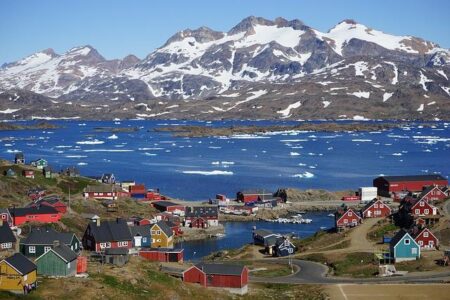



The White House confirmed on Monday that President Donald Trump has entertained multiple avenues for bringing Greenland under greater U.S. control, even contemplating the use of American military assets as part of the equation. The acknowledgment, first reported by Reuters, highlights Washington’s deepening strategic focus on the Arctic and on Greenland in particular-an island rich in minerals and critical to North Atlantic security. What once sounded like an offhand idea about “buying” Greenland has evolved into a more structured examination inside the administration, prompting renewed concern among U.S. allies, legislators, and security experts about how far this ambition might go.
Trump’s Greenland Strategy: From “Real Estate Idea” to Legal, Diplomatic and Economic Playbook
Behind the scenes, the Trump administration has been probing how a modern‑day territorial arrangement for Greenland might be crafted without breaking international norms. Policy and legal teams have revisited historical precedents-from the 1867 Alaska Purchase to Cold War‑era basing and trusteeship agreements-to understand what a 21st‑century deal could look like.
Legal advisers are exploring several structural options: a classic treaty approved by the U.S. Senate, a multi‑decade lease arrangement, or a bespoke framework that preserves formal Danish sovereignty while granting Washington sweeping rights over defense facilities and resource development. At the same time, U.S. diplomats have been quietly gauging how far both Copenhagen and Nuuk might be willing to go, trying to respect Greenland’s self‑rule while openly signaling America’s interest in expanding its Arctic presence and countering Russian and Chinese advances in the region.
Parallel to these legal and diplomatic inquiries, internal strategy papers in Washington outline what a package of enticements for Greenland could involve. Officials who have seen early drafts describe a bundle of incentives designed to appeal to both the island’s leadership and its roughly 56,000 residents, including major infrastructure commitments and economic partnerships.
Key strands of this emerging strategy include:
- Legal mechanisms – full treaty‑based transfer, long‑horizon lease, or a special autonomous framework granting the U.S. extensive operating rights.
- Economic incentives – investment in ports, upgraded airfields, subsea cables and broadband, as well as joint ventures in mining and critical minerals.
- Security guarantees – tighter integration with NORAD, expanded Arctic patrols, enhanced early‑warning radar and air defense coverage.
- Diplomatic assurances – formal recognition of Greenlandic cultural identity, language rights, and expanded political autonomy.
As debates unfold, several primary scenarios have been mapped out with their strategic upsides and inherent risks:
| Scenario | Key Benefit | Main Risk |
|---|---|---|
| Full Purchase | Enduring U.S. foothold in the Arctic with maximum control | Intense political backlash in Denmark and potential EU friction |
| Long‑Term Lease | Strategic access without formal redrawing of borders | Ongoing disputes over sovereignty, jurisdiction, and legal authority |
| Defense Compact | Greater basing rights, radar coverage, and logistical hubs | Domestic resistance in Greenland over perceived loss of agency |
Military Dimension in the Spotlight: How Far Could the Pentagon Be Drawn In?
As talk of acquiring Greenland shifted from a curiosity to a more structured policy question, the Pentagon’s potential role has come under sharper review. Officials stress that there has been no formal order to reposition U.S. forces in the Arctic, but the White House’s repeated insistence that “all options remain on the table” has unsettled lawmakers and defense specialists.
Critics caution that mixing long‑range force‑posture planning with a highly transactional territorial bid risks confusing allies and eroding NATO cohesion. They point out that America has long relied on predictable signaling in the North Atlantic, and that framing U.S. power projection in the language of a real‑estate transaction could be deeply destabilizing.
Inside the Defense Department, planners are nonetheless being asked to war‑game contingencies that go beyond routine basing agreements or radar upgrades. Working papers circulated among senior officers weigh potential gains against diplomatic blowback, focusing on issues such as deterrence, alliance management, and the legal status of any military activity linked to a territorial “deal.”
Some of the core military considerations include:
- Expanded Arctic footprint to strengthen missile‑warning systems, anti‑submarine warfare capacity, and northern air defense corridors.
- Heightened friction with Denmark and broader European allies wary of unilateral U.S. maneuvering in a sensitive region.
- Increased tension with Russia and China, both of which have been steadily stepping up their use of polar routes and Arctic infrastructure.
- Legal ambiguity around the use of force in support of a contested sovereignty negotiation framed as a “purchase” rather than a classic territorial dispute.
These questions translate into several visible posture options, each sending very different signals:
| Scenario | Military Signal | Allied Reaction |
|---|---|---|
| More Arctic exercises | Demonstrates readiness and commitment to regional defense | Cautious support paired with calls for transparency |
| New permanent base | Strong power‑projection message toward Russia and China | Noticeable unease in Europe over potential escalation |
| Link posture directly to territorial deal | Viewed as coercive leverage tied to negotiations | Likely strong public and diplomatic pushback among NATO allies |
How Allies, Nordic Governments, and Arctic Communities See the Greenland Question
Reactions across Europe and the Arctic have been swift and skeptical. Danish leaders have reiterated that Greenland “is not for sale,” framing the island’s status as a matter of constitutional principle as well as national pride. Nordic foreign ministers, while more guarded in public, have privately questioned whether Washington’s posture signals a shift toward a more zero‑sum, great‑power approach to the High North.
Indigenous and Greenlandic representatives have been even more pointed. Inuit leaders emphasize that their homeland cannot be treated as a token in global power politics, underscoring long‑standing claims to self‑determination, land rights, and cultural preservation. They insist that any discussion about Greenland’s future must start with the people who live there, not with external powers trading maps.
Within NATO, officials worry that casual references to military options-made in the context of acquisitive rhetoric-could blur the distinction between normal alliance planning and coercive signaling. That concern is amplified by the broader context: the Arctic has rapidly become a nexus for security, energy, and climate debates.
Analysts and regional stakeholders highlight several intertwined pressure points:
- Sovereignty: Competing claims over maritime routes, airspace, subsea cables, and seabed resources in a region where ice loss is redrawing navigational charts.
- Defense posture: The challenge of reinforcing U.S. and allied presence without triggering an arms‑race dynamic or undermining existing confidence‑building measures.
- Climate risks: Accelerating ice melt opening new shipping lanes and resource prospects, even as Arctic communities grapple with erosion, permafrost thaw, and ecosystem disruption.
- Indigenous rights: Sustained demands from Inuit and other Arctic peoples for meaningful participation in any talks that affect their territories, waters, and livelihoods.
The range of actors involved underscores how multi‑layered the Greenland issue has become:
| Actor | Primary Concern |
|---|---|
| Denmark | Protecting territorial integrity and constitutional arrangements |
| Greenlandic leaders | Safeguarding self-governance, resource control, and cultural rights |
| NATO allies | Maintaining alliance cohesion and predictable security planning |
| Arctic Council members | Preserving regional stability while advancing climate and environmental policy |
Calls for Guardrails: How Experts Want to Structure Any Future U.S. Territorial Ambitions
Scholars of international law and security policy argue that if Washington is to revisit the question of territorial acquisition in any form, it must do so within a clearly defined legal and ethical framework. They reject the idea that such consequential decisions can be improvised in response to shifting political winds or media cycles.
One core recommendation is that Congress establish transparent criteria for when and how the United States may explore territorial negotiations. These benchmarks would include requirements that local populations explicitly consent, that alliance structures are not destabilized, and that environmental, financial, and strategic risks are publicly assessed. Experts stress that U.S. military capabilities must be seen as tools of deterrence and defense-not bargaining chips to increase pressure in quasi‑commercial talks.
To reinforce these norms, analysts are urging statute‑based oversight mechanisms designed to prevent unilateral moves by the executive branch from reshaping the global map. Proposed measures center on regular reporting, independent scrutiny, and mandatory consultation steps before any negotiation proceeds.
Recommended safeguards include:
- Legally enforceable consultation processes with affected communities and Indigenous groups.
- Pre‑negotiation approval thresholds in both the House and Senate before formal talks begin.
- Publicly released cost‑benefit and risk assessments prior to advancing any territorial framework.
- Strict institutional separation between defense planning and territorial bargaining to avoid conflating deterrence with coercion.
These ideas translate into a set of potential guardrails:
| Guardrail | Primary Goal |
|---|---|
| Congressional pre-clearance | Constrain unilateral executive authority over territorial negotiations |
| Public impact reports | Give voters, allies, and local communities access to key information |
| Local consent standard | Ensure self-determination and community buy‑in |
| Use-of-force firewall | Prevent military power from being weaponized as a bargaining tool |
Conclusion: Greenland, the Arctic, and the Future of U.S. Strategy
For now, the idea of a formal U.S. acquisition of Greenland remains speculative. No binding proposal has been presented by Washington, nor has Copenhagen signaled any willingness to contemplate a transfer of sovereignty. Yet the White House’s refusal to categorically rule out military options reveals how central Arctic calculations have become to American foreign and defense policy.
As Russia, China, and other regional players deepen their footprint in the High North-with new ports, icebreakers, and energy projects-Greenland is likely to remain at the crossroads of security planning, climate politics, and great‑power rivalry. Even if the specific notion of “buying” the island never advances, the debates it has triggered over sovereignty, alliance management, and the limits of U.S. territorial ambition will continue to shape how Washington approaches the Arctic for years to come.