

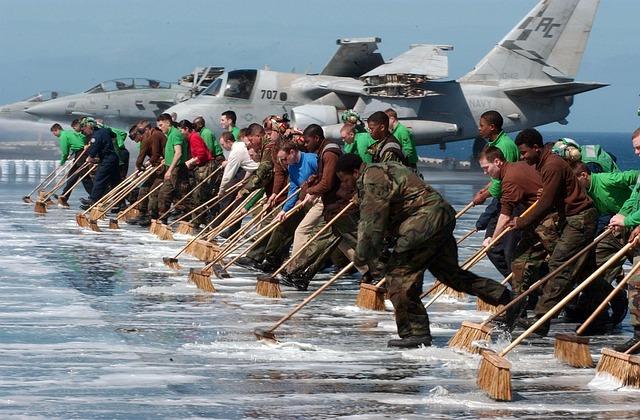
BUSAN, Republic of Korea – The USS George Washington (CVN 73) Carrier Strike Group has departed Busan, wrapping up a high-visibility port call that reaffirmed Washington’s long-term commitment to security and stability on the Korean Peninsula and throughout the wider Indo-Pacific. The visit featured extensive joint activities with the Republic of Korea (ROK) Navy and outreach to local communities, reinforcing the depth and durability of the U.S.–ROK alliance at a time of mounting regional security concerns.
Regional security significance of the USS George Washington strike group departure
The strike group’s departure from Busan is far more than the end of a routine visit; it is a carefully calibrated signal of U.S. resolve and readiness in Northeast Asia. For defense planners in the region, the movements of a carrier strike group serve as a real-time barometer of crisis responsiveness, alliance cohesion, and the broader U.S. approach to deterrence—especially as North Korea continues ballistic missile launches and China sustains gray-zone pressure at sea.
By redeploying from Busan, the U.S. Navy underscores its ability to shift substantial combat power quickly between key maritime flashpoints—from the Yellow Sea to waters around Japan and the Philippine Sea—while preserving political flexibility to back either diplomatic engagement or firm deterrence, depending on how events unfold.
- Signal to allies: Reinforces U.S. extended deterrence and joint naval readiness with both the Republic of Korea and Japan.
- Message to rivals: Demonstrates enduring U.S. capacity to project air and sea power despite simultaneous global commitments.
- Operational agility: Showcases the ability to rapidly reassign high-end assets across Indo-Pacific contingencies.
- Defense integration: Promotes deeper interoperability in missile defense, anti-submarine warfare (ASW), and air operations among regional partners.
| Strategic Area | Key Impact |
|---|---|
| Deterrence Posture | Strengthens credibility of U.S. security guarantees |
| Alliance Dynamics | Supports trilateral ROK–U.S.–Japan coordination and planning |
| Maritime Domain | Complicates planning and risk calculus for potential adversaries |
| Crisis Management | Enables faster, more flexible control of escalation at sea |
Across the Indo-Pacific, the strike group’s onward transit is expected to influence the timing and scale of upcoming exercises, freedom of navigation operations, and intelligence-sharing initiatives. Analysts increasingly emphasize “integrated deterrence,” where carrier air wings, Aegis-equipped destroyers, submarines, and allied units operate as a tightly connected, multi-domain network rather than separate national formations.
As governments monitor the George Washington’s next operating areas—from waters near the Korean Peninsula to contested zones in the South and East China Seas—its presence, and equally its absence, will be read as a clear indicator of U.S. priorities and risk assessments in the evolving regional security environment.
Combined training gains with Republic of Korea naval forces
During its time in and around Busan, the USS George Washington Carrier Strike Group conducted an intensive slate of joint drills with ROK Navy units, building on decades of close cooperation. These evolutions were crafted to validate combined command-and-control (C2) frameworks, refine maritime interdiction procedures, and sharpen integrated air and missile defense tactics.
Carrier-based aircraft executed coordinated sorties with ROK Navy aviation platforms, while surface ships from both nations practiced complex maneuvering, live communications checks, and layered defense scenarios under realistic conditions. A strong emphasis was placed on rapid information-sharing and decision-making, ensuring U.S. and ROK command teams can move seamlessly from routine presence to crisis response when required.
- Enhanced interoperability via shared tactics, techniques, and procedures across air, surface, and subsurface domains.
- Improved readiness for maritime security missions and higher-end regional contingency operations.
- Refined C2 architecture enabling more efficient joint and combined task force operations.
- Sustained presence that supports a free and open Indo-Pacific and reassures regional partners.
| Focus Area | Joint Outcome |
|---|---|
| Air & Missile Defense | Accelerated joint tracking, cueing, and engagement decisions |
| Maritime Interdiction | More efficient boarding procedures and standardized evidence handling |
| Communications | Stronger, real-time cross-domain data exchange |
| Logistics Support | Better coordinated resupply, maintenance, and port operations in Busan |
Leaders from both navies stressed that the real measure of success lay not in any single event, but in the repeatability and reliability of their combined performance. With planners, watchstanders, and aircrews integrated at every level, the forces stress-tested surge capacity, rehearsed the rapid reinforcement of the peninsula, and confirmed the systems and processes needed to shift from bilateral coordination to fully integrated combat operations if circumstances demand it.
Lessons learned from these engagements will shape upcoming training cycles, with both navies reporting tangible improvements in coordination speed, targeting precision, and the breadth of credible joint response options across the full spectrum of maritime operations—from peacetime patrols to high-intensity conflict.
Deterrence and freedom of navigation in the Indo-Pacific theater
The USS George Washington’s departure from Busan sends a powerful, visible element of credible combat power back into a region already marked by recurring missile tests, coercive gray-zone activities, and intensifying competition over maritime claims. By operating near strategic sea lanes and chokepoints, the strike group buttresses alliance commitments and conveys that efforts to change the status quo at sea through intimidation or force will face coordinated opposition.
With a fully integrated carrier air wing and multi-mission escorts at sea, commanders gain a broad toolkit—from routine patrols and joint drills to rapid crisis response—all under a deterrence posture designed to discourage miscalculation and escalation. This presence also bolsters continuous domain awareness, linking surface vessels, submarines, aircraft, space-based assets, and cyber capabilities to monitor potential flashpoints and provide early warning across the Indo-Pacific.
For regional states that rely on uninterrupted maritime trade through critical chokepoints such as the Strait of Malacca and the Korea Strait, the strike group’s operations highlight a shared stake in keeping commercial shipping lanes open, predictable, and secure. Combined patrols, multinational exercises, and transits through contested waters send a clear message that freedom of navigation is underwritten by interoperable forces and enduring presence—not simply by diplomatic statements.
Key facets of this posture include:
- Persistent presence in international waters to deter coercive or unsafe behavior.
- Combined operations with allies and partners to signal unity and shared responsibility for regional stability.
- Rapid surge capacity to respond quickly to incidents at sea or in the air, from confrontations to accidents.
- Information sharing that enhances collective maritime domain awareness and incident response.
| Focus Area | Operational Effect |
|---|---|
| Sea Lane Security | Decreases risk of disruption to key trade and energy routes |
| Allied Exercises | Boosts readiness and interoperability among regional navies |
| Visible Presence | Signals resolve and deters opportunistic actions by potential adversaries |
| Integrated Surveillance | Improves early warning, crisis management, and escalation control |
Policy pathways to sustain allied maritime presence and crisis response
To ensure that carrier strike group deployments like that of the USS George Washington remain both routine and credible, defense strategists are urging governments to move from ad hoc port calls toward a more institutionalized model of forward presence. This shift involves multi-year access arrangements with host nations, standardized rules for logistics and maintenance support, and shared funding mechanisms that shield critical deployments from short-term domestic budget fluctuations.
Experts also advocate expanding multinational maritime task groups under existing frameworks—such as arrangements associated with the UN Command, cooperation among Quad nations, and coordination with NATO partners. Such coalitions can enable quicker, politically pre-cleared surges for freedom of navigation operations, maritime security patrols, and humanitarian assistance missions.
- Institutionalize rotational carrier and amphibious deployments through predictable schedules and transparent public communication.
- Upgrade and harden ports like Busan with dual-use infrastructure capable of rapid refueling, rearming, and repair during crises.
- Integrate allied command-and-control networks to compress decision timelines for deterrence missions and disaster relief.
- Expand trilateral drills among the United States, Republic of Korea, and Japan to include cyber, space, and unmanned maritime systems.
| Priority Area | Key Action | Intended Effect |
|---|---|---|
| Presence | Regular CSG and ESG rotations | Consistent, visible deterrent posture |
| Logistics | Shared fuel, munitions, and repair capacity | Faster, more resilient surge capability |
| Interoperability | Common training, data standards, and operating procedures | Seamless joint and combined operations |
| Crisis Response | Preplanned HADR and noncombatant evacuation playbooks | Quicker, more coordinated civilian relief at sea |
Regional governments are additionally encouraged to connect maritime posture directly to broader whole-of-government crisis planning. The goal is for carrier strike groups to deploy with diplomatic, economic, legal, and information tools already aligned before any emergency unfolds. This would see navies training not only for high-end combat, but also for sanctions enforcement, maritime law operations, noncombatant evacuations, and coordinated disaster response with coast guards and civilian agencies.
By embedding these elements into long-term alliance roadmaps, policymakers can ensure that high-profile departures from ports such as Busan become reliable pillars of regional security architecture—predictable signals of allied resolve rather than isolated demonstrations of force.
Future Outlook
As the USS George Washington Carrier Strike Group steams away from Busan, its departure highlights both the routine rhythm of carrier operations and their central role in upholding regional stability. While the strike group transitions to its next set of missions, the impact of the port visit lingers—in reinforced partnerships, tested interoperability, and a visible reaffirmation of the U.S. Navy’s pledge to maintain a free and open Indo-Pacific.
With the strike group now at sea, commanders underscore that the broader mission extends well beyond a single visit or exercise cycle. From the waters off the Korean Peninsula to the wider Pacific, the continued presence of the USS George Washington and her escorts will stand as a tangible symbol of collective security commitments, even as Busan resumes its familiar peacetime tempo along one of Asia’s busiest waterfronts.