

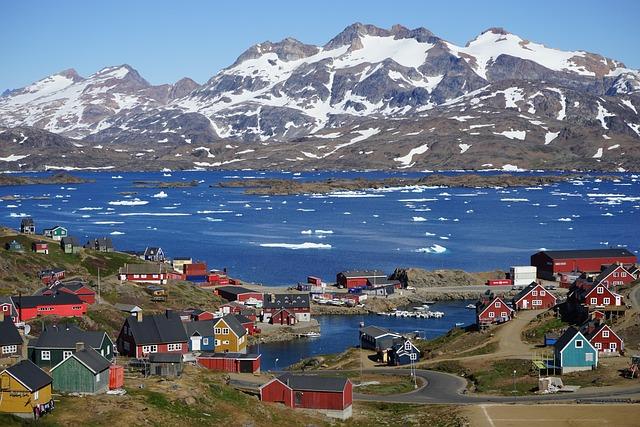
US President Donald Trump’s threat to impose new tariffs on countries that opposed his idea of buying Greenland has sharpened a diplomatic clash with some of Washington’s closest allies. The controversy, sparked by Denmark’s blunt refusal to consider selling the vast Arctic territory, has complicated relations between the United States and Copenhagen and added to wider European unease over the use of trade leverage as a foreign policy tool. The timing is particularly sensitive: a bipartisan US congressional delegation has arrived in Denmark to cool tempers, even as European governments brace for possible new retaliatory tariffs and a prolonged chill in transatlantic relations.
Tariff threats over Greenland dispute deepen transatlantic tensions
The fallout from the rejected Greenland purchase has moved far beyond an unusual real-estate style proposal. Senior US officials now signal that allies perceived as blocking Washington’s “strategic expansion” in the Arctic could be hit with targeted trade measures. Draft plans reportedly focus on politically exposed sectors in Europe, ranging from agricultural exports to premium manufacturing and consumer brands.
In Brussels and Copenhagen, diplomats have condemned the approach as an overt attempt to weaponise trade over a diplomatic disagreement, while trade lawyers warn that any new US duties are likely to trigger swift challenges at the World Trade Organization and coordinated retaliatory tariffs from the European Union. European capitals, already unsettled by earlier US–EU trade frictions, are treating the Greenland dispute as a test case for how far Washington is willing to push economic coercion against long-standing NATO partners.
- Core flashpoint: mooted US levies aimed at governments that publicly opposed Washington’s ambitions in the Arctic region.
- European counter-move: accelerated consultations among EU trade and foreign ministers to craft a unified, rules-based response.
- US domestic worries: concern from lawmakers in both parties and from farm lobbies that further trade wars could again hit US exporters.
| Region | Likely Target Sector | Political Risk |
|---|---|---|
| EU | Dairy & luxury goods | High |
| Nordic states | Shipping & fisheries | Medium |
| US | Farm exports exposed to backlash | Rising |
The Arctic context magnifies these disputes. As climate change opens previously inaccessible sea routes, global interest in the region’s energy reserves, mineral wealth and strategic military routes has surged. According to the US Geological Survey, roughly 13% of the world’s undiscovered oil and 30% of its undiscovered natural gas may lie north of the Arctic Circle, much of it offshore. That scale of potential resource wealth intensifies the stakes of any clash involving Greenland, which sits at the crossroads of North Atlantic shipping and Arctic air and sea routes.
Arriving against this backdrop, the bipartisan US delegation in Denmark is attempting to lower the temperature. Meetings with Danish officials, Greenlandic leaders and security analysts focus on NATO cooperation, climate research and critical mineral supply chains. Members of Congress have publicly sought to draw a line between their visit and the White House’s more combative messaging, even as they insist on safeguarding US strategic interests in the High North. Their efforts highlight how a rejected territorial suggestion has morphed into a broader trial of alliance solidarity, trade stability and the perceived reliability of American diplomacy.
Danish policymakers model economic shockwaves from possible US tariffs
In Copenhagen, ministries are quietly working through scenarios that until recently seemed hypothetical. Denmark is deeply integrated into transatlantic commerce, and any new American levies on key exports could reverberate through its tightly connected economy. Officials are actively reviewing Denmark’s exposure in sectors such as pharmaceuticals, maritime services and agri‑food, while industry groups warn that even narrow, symbolic measures can rattle investor confidence and complicate long-term planning.
Economic teams are not only calculating the direct impact of tariffs but also secondary shocks: currency movements, potential rerouting of global supply chains and the risk that multinational firms might start to see Denmark as a less predictable gateway to the broader European market. This kind of reassessment has become more common across Europe; an OECD analysis published in 2023 estimated that persistent trade tensions could reduce global GDP by up to 1% in the medium term, with small, highly open economies like Denmark among the most vulnerable.
- Primary concern: loss or dilution of preferential access to the US market.
- Short‑term risk: EU‑wide retaliation that widens the dispute beyond Denmark and complicates intra‑European supply chains.
- Long‑term fear: erosion of Denmark’s image as a predictable, trusted ally and trading partner.
| Sector | US Exposure | Main Risk |
|---|---|---|
| Pharma & Biotech | High | Regulatory delays, higher import costs |
| Shipping & Logistics | Medium | Route diversion, contract renegotiations |
| Dairy & Food | Targeted | Loss of niche premium markets |
Political risk assessments, not official trade statistics.
Parallel to its economic risk mapping, Denmark is reassessing the broader strategic balance of its relationship with Washington. Senior advisers are acutely aware that open confrontation could set a precedent for how the US treats smaller NATO allies that resist highly public demands from the White House. A prolonged rift could hinder cooperation on Arctic surveillance, submarine tracking, intelligence sharing and the ongoing debate over NATO burden-sharing.
While visiting members of Congress have signalled a desire to shield defence ties from the fallout of trade disputes, Danish officials are quietly exploring an array of contingency options. These range from pushing for unified EU‑level responses to selectively strengthening bilateral cooperation with US agencies in areas like cyber defence, climate research and space monitoring. The aim is to contain the dispute before it calcifies into a durable geopolitical fault line.
US congressional delegation works to reassure Denmark and steady NATO cooperation
The arriving US lawmakers face a complex assignment: to calm a close ally while implicitly criticising the tone of recent presidential statements without triggering an open institutional split in Washington. In private briefings at Christiansborg and joint press appearances, members of the delegation have repeatedly underlined continuity in security cooperation, emphasising that Denmark remains a central partner in broader US and NATO strategy.
They have pointed to decades of joint operations—from Baltic air policing missions to naval deployments in the North Atlantic and contributions to coalition efforts in Iraq and Syria—as evidence that the underlying defence relationship remains resilient. The message is that, while rhetoric from the White House may swing dramatically from one news cycle to the next, day‑to‑day military and intelligence cooperation continues largely unchanged.
To both Danish leaders and the wider European audience, the delegation has framed its mission around three core themes:
- Respect for Danish sovereignty over Greenland and the Faroe Islands, including recognition of the role of Greenland’s own elected government.
- Predictability in NATO planning, particularly with regard to deterrence and reinforcement strategies in the Baltic Sea and Arctic regions.
- Pragmatic economic dialogue aimed at preventing a spiral into a new transatlantic tariff battle that could undermine growth on both sides of the Atlantic.
| Priority | Delegation Message |
|---|---|
| Security | Deepen joint NATO exercises and expand Arctic monitoring |
| Diplomacy | Rebuild trust through frequent high‑level visits and structured dialogue |
| Trade | Search for alternatives to new tariffs on EU partners |
In practice, that could include establishing a regular US–Denmark–Greenland strategic dialogue and reviving broader US–EU trade talks with a specific Arctic component. The delegation is also keenly aware that Europeans are watching US domestic politics closely. With public opinion surveys across Europe showing declining trust in American leadership since the late 2010s, Congressional diplomacy has taken on a more prominent role in signalling long-term commitments that outlast a single administration.
Experts call for Arctic trade carve-outs, structured dialogue and a clearer regional strategy
Policy specialists across the Atlantic argue that the Greenland episode exposes a deeper problem: the lack of a stable, long-term framework for Arctic governance and economic cooperation. Rather than allowing ad hoc tariff threats to define relations, analysts in Washington, Brussels and Nordic capitals are pushing for a more systematic approach that would insulate critical areas of cooperation from day‑to‑day political disputes.
One emerging idea is the creation of tightly defined trade carve-outs for essential Arctic-related goods and services, from rare earth minerals used in clean energy technologies to satellite and communications components needed for polar navigation and climate monitoring. By anchoring these carve-outs in existing trade agreements, negotiators hope to protect vital supply chains and scientific work, while adding verification mechanisms and joint monitoring teams to prevent loopholes and disguised militarisation.
Security experts caution that such economic measures must be nested within a broader strategic vision for the “High North.” They urge Western governments to articulate a shared agenda that balances resource development and commercial access with environmental safeguards and the rights of indigenous communities. A number of priorities are frequently cited as building blocks for a more durable Arctic order:
- Formal dialogue channels linking Washington, Copenhagen and Nuuk, designed to address disputes before they escalate into sanctions or public confrontations.
- Protected trade corridors for energy, shipping and digital infrastructure, explicitly shielded from retaliatory tariffs to ensure long‑term investment.
- Robust environmental standards governing ports, mining and research bases, backed by transparent impact assessments and independent monitoring.
- Inclusive governance mechanisms that grant Greenlandic institutions and other Arctic communities a structured voice in major decisions.
| Proposal | Primary Goal | Key Stakeholders |
|---|---|---|
| Arctic Trade Carve-Outs | Shield critical supply chains from tariff disputes | US, EU, Greenland |
| Security Dialogue Forum | Lower the risk of military miscalculation | NATO, Denmark, US |
| Greenland Impact Council | Embed local and indigenous voices in major deals | Greenland govt, Indigenous groups |
Alongside these proposals, analysts have floated ideas such as expanding joint Arctic research missions, setting shared rules for search‑and‑rescue operations as shipping routes grow busier, and promoting green infrastructure in northern ports. Together, these measures could help lower tensions by making clear that competition in the Arctic will play out within agreed boundaries rather than through sudden tariff shocks or unilateral provocations.
Looking ahead: can Washington and Copenhagen move beyond the Greenland dispute?
As the US congressional delegation continues its discussions in Copenhagen, both capitals appear interested in turning the page on the turbulence unleashed by President Trump’s remarks and subsequent tariff threats. Yet the incident has laid bare just how rapidly trade policy and security alliances can become entangled with domestic politics and presidential messaging.
With no concrete purchase proposal for Greenland on the table—and Denmark repeatedly affirming that the territory is not for sale—the debate is likely to re-centre on the wider trajectory of US‑European relations and the future of Arctic governance. Whether the Greenland flare-up fades as a temporary diplomatic anomaly or marks the start of more entrenched friction will depend on the next moves from the White House, the resolve of Congress to preserve partnership channels, and how America’s European allies choose to calibrate their response.
What is already clear is that the Arctic is no longer a peripheral issue. As melting ice, geopolitical rivalry and technological change converge in the region, episodes like the Greenland dispute will increasingly serve as barometers of the health of the transatlantic relationship—and of the ability of allies to manage strategic competition without letting it spiral into open economic conflict.