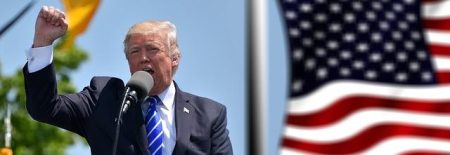




Former President Donald Trump is scheduled to headline a prominent Christian prayer event that has already sparked intense pushback from clergy, constitutional scholars, and civil rights advocates who see it as a showcase for Christian nationalism. Marketed as a nonpartisan moment of collective prayer, the gathering is emerging as a flashpoint just as Trump ramps up his 2024 outreach to evangelical and conservative Christian voters.
Organizers present the event as an appeal for spiritual renewal and moral clarity in turbulent times. Detractors counter that its message elevates one religious identity as uniquely “American” and blurs the constitutional boundary between church and state. Trump’s appearance highlights how closely his political brand remains tied to segments of the religious right, and it is renewing debate over religious pluralism, democracy, and the proper role of faith in U.S. politics.
Trump’s prayer event appearance reignites debate over Christian nationalist themes
Trump’s decision to share the stage at the high-profile gathering is being closely watched by religious leaders, civil rights groups, and political observers who argue that the event blends devotion with partisan mobilization. Critics say the program has increasingly leaned into Christian nationalist themes, mixing patriotic imagery, prophetic-style language, and urgent appeals around elections into a narrative that suggests America has a divinely mandated religious identity tied to a particular political project.
Supporters of the gathering insist that it is a constitutionally protected exercise of religious liberty, not a bid for theocracy. They argue that inviting national politicians—of any party—to speak simply reflects broad anxiety about the country’s moral and cultural trajectory. From their perspective, engaging with public officials is part of a long tradition of faith communities speaking into national life.
Yet watchdog organizations point to rhetoric and symbolism they say signal a shift from conventional faith-based outreach to a more ideologically rigid message. They highlight recurring patterns such as:
- Blending religious authority with state power, as prayers and sermons invoke government institutions and elected officials as instruments of a divine plan.
- Repeated claims that the nation’s “God-given destiny” is bound up with loyalty to a specific leader or movement.
- Policy demands cast as “spiritual warfare,” portraying debates over law and public policy as battles between good and evil rather than democratic disagreement.
- One-sided appeals to religious freedom, emphasizing protections for conservative Christians while downplaying the rights of other religious or nonreligious communities.
| Key Stakeholder | Main Concern |
|---|---|
| Faith Leaders | Turning worship into a campaign vehicle |
| Civil Rights Groups | Marginalization of religious minorities and nonbelievers |
| Political Analysts | Weakening of the church–state wall envisioned by the Constitution |
How religious rhetoric and partisan politics are being fused on stage
At the heart of the controversy is how the gathering spiritually frames political allegiance. Prayers, Scripture readings, and worship songs are used to portray contemporary policy fights as episodes in a cosmic struggle for the soul of the nation. Speakers routinely ground stances on immigration, the courts, education policy, and cultural issues in selected biblical passages, suggesting that disagreement is not just political—but a rejection of God’s purposes.
Stagecraft reinforces that message: American flags lined up behind pulpits, campaign-style taglines projected alongside crosses, and slogans about “reclaiming America for Christ” that echo stump speeches more than traditional sermons. The atmosphere resembles a rally as much as a revival.
Critics argue that this approach is especially troubling because specific partisan goals are wrapped in religious language and treated as non-negotiable truths of the faith. In this environment, “spiritual warfare” rhetoric is frequently aimed at rival political parties, the media, or secular institutions, while calls for unity are largely directed at those who accept a particular partisan agenda. Religious identity becomes a marker of political loyalty, and houses of worship function as organizing hubs. Typical messages emphasize:
- Election results described as acts of God, victories for “the faithful,” or judgments on national righteousness.
- Policy disagreements reframed as moral ultimatums, leaving little room for compromise or pluralistic negotiation.
- Opponents characterized with spiritualized labels—from “forces of darkness” to “enemies of faith”—rather than as fellow citizens.
- America’s future depicted as dependent on the success of a single candidate, party, or ideological platform.
Christian nationalism’s effects on democracy, religious freedom, and social trust
Opponents of the event caution that conflating a narrow version of Christianity with national identity can erode core democratic norms. When policy agendas are presented as the explicit will of God, dissenters can be painted not merely as wrong, but as threats to both faith and country. This dynamic encourages voters to rally around theological absolutes instead of shared civic principles, turning political life into a moral battlefield rather than a space for compromise.
Civil liberties advocates warn that such rhetoric can weaken independent institutions, from the courts to the press, by casting them as illegitimate if they resist a religious-political program. Loyalty to a leader or movement may begin to outweigh commitment to the Constitution, checks and balances, and equal protection under the law. Many clergy who reject Christian nationalism argue that once faith is welded to state power, it stops being a matter of conscience and becomes a means of control.
The rise of Christian nationalist messaging also tests religious freedom and social cohesion. Minority faith communities—as well as the growing number of Americans who identify as religiously unaffiliated—report heightened anxiety about being treated as second-class citizens. According to recent surveys from the Pew Research Center, roughly a quarter of U.S. adults now identify as religious “nones,” underscoring how diverse the country’s religious landscape has become. Yet rhetoric asserting that the United States was “founded as a Christian nation” can translate into political pressure on schools, local officials, and courts to favor one faith tradition.
In practice, this may surface in conflicts over religious symbols on public property, taxpayer funding for religious institutions, or the framing of history and civics in classroom curricula. Analysts point to emerging fractures in several areas:
- Public policy debates increasingly couched in sectarian language that excludes or stigmatizes those outside a particular religious camp.
- Rising polarization as religious identity overlaps more directly with partisan affiliation and cultural divides.
- Deepening mistrust among minority faith communities, atheists, agnostics, and humanists who fear losing equal standing in public life.
| Area | Potential Effect |
|---|---|
| Democratic Institutions | Pressure to align laws and rulings with a single theology |
| Religious Freedom | Deterrence of minority faith expression and public participation |
| Social Cohesion | Deeper cultural rifts and hardened partisan identities |
Policy tools and local strategies to respond to religious-political extremism
Policy experts say the Biden administration, along with governors and state election officials, faces growing calls to confront the expanding role of faith-branded political events that push the limits of nonpartisanship. While the First Amendment provides broad protection for religious expression, analysts emphasize that existing law already draws lines around direct campaigning and misuse of charitable status.
Proposed responses include heightened enforcement of IRS regulations for tax-exempt religious organizations, more explicit federal guidance on church-based electioneering, and stronger disclosure rules for donors and sponsors of large-scale prayer rallies that double as political events. Civil rights advocates are also pressing Congress to shore up protections for minority religions and nonreligious Americans, arguing that government engagement with such gatherings must avoid signaling endorsement of any specific doctrine.
Potential policy actions often center on:
- Reinforcing church–state separation in campaign activities, ensuring religious entities do not function as de facto partisan machines while maintaining their freedom to speak on moral issues.
- Monitoring hate speech and incitement under existing civil rights and criminal statutes, particularly when religious language is used to justify harassment or violence.
- Investing in civic education that highlights constitutional principles, pluralism, and the rights of religious and nonreligious minorities in public schools and adult education programs.
- Backing interfaith coalitions that explicitly reject Christian nationalism and promote a vision of religious cooperation compatible with democratic norms.
| Strategy | Main Actor | Goal |
|---|---|---|
| Legal oversight of rallies | Justice Dept. | Enforce civil rights protections and campaign law |
| Public fact-checking | Newsrooms | Challenge disinformation and clarify church–state rules |
| Local dialogue forums | Community groups | Foster cross-faith understanding and reduce polarization |
At the grassroots level, pastors, lay leaders, and organizers are experimenting with alternative models of public faith that decouple spiritual life from party loyalty. Interfaith councils in cities and suburbs alike are hosting joint prayer services, nonpartisan voter education nights, and media literacy workshops designed to help congregants recognize apocalyptic conspiracy narratives and manipulative political messaging.
In key battleground states, neighborhood networks and faith-based nonprofits are forming rapid-response teams to track extremist content online, reach out to congregations feeling politically disenfranchised, and offer resources that frame democratic participation—not allegiance to any single candidate—as a core moral responsibility. Some churches are organizing study groups on religious freedom and pluralism, while synagogues, mosques, and temples are collaborating on public events underscoring that no one tradition owns the American story.
Conclusion: What Trump’s appearance signals about the future of faith and politics
As the gathering draws nearer, Trump’s participation is poised to sharpen the national conversation over how religion should operate in the public square and how openly Christian nationalist ideas are now expressed in conservative politics. Supporters portray the event as a bold exercise of religious liberty and moral clarity in a time of cultural upheaval. Opponents view it as a troubling fusion of worship and partisanship that strains constitutional limits.
With the 2024 presidential election approaching, the messages delivered on that stage—and the public reaction beyond it—may preview the next phase of America’s cultural and political conflicts. Whether voters embrace or resist Christian nationalist themes could shape not only campaign strategies, but also the country’s long-term commitment to religious pluralism and democratic governance.