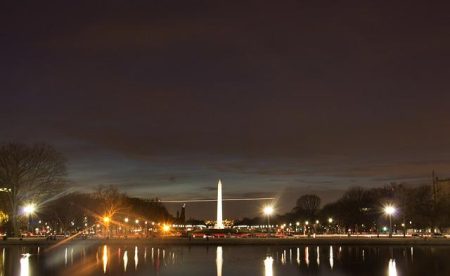


Former President Donald Trump on Wednesday proclaimed that Washington, D.C., had effectively become a “crime free zone,” even as fresh Metropolitan Police Department records documented hundreds of incidents across the city in just one week. Trump’s declaration, delivered as part of a broader effort to spotlight crime in Democratic-led jurisdictions, collided head-on with new data showing 442 reported offenses in the nation’s capital during the same seven-day span. The contradiction highlights a widening divide between campaign messaging and the day-to-day realities reflected in official crime statistics.
Trump’s “Crime Free Zone” vs. On‑the‑Ground Crime Trends in Washington, D.C.
Speaking at a rally, Trump portrayed Washington as a city where “violent lawlessness” had been effectively erased, suggesting that the capital had turned the page on years of public safety concerns. Yet the Metropolitan Police Department’s most recent weekly summary told a sharply different story, listing nearly five hundred reported incidents ranging from violent crimes to property and vehicle-related offenses.
Local officials continue to authorize overtime patrols, neighborhood watch groups still trade alerts about thefts and carjackings, and residents say sirens, not silence, define their evenings. For many in D.C., the “crime free zone” label has become a symbol of a broader struggle over who gets to define what safety looks like: national political figures seeking a sound bite, or communities living with the consequences of crime and enforcement every day.
The latest report from D.C. police makes clear that the week in question was active, not tranquil. Incidents were clustered in busy commercial corridors, nightlife districts, and transportation hubs, reflecting persistent trouble spots rather than a city where crime has receded into the background. While monthly and yearly trends can move up or down, the short-term snapshot reveals an ongoing challenge, not a clean slate.
- Violent incidents occurring in and around entertainment districts and transit centers
- Property crimes affecting small businesses, apartment buildings, and rowhouse blocks
- Vehicle-related offenses such as auto theft, break-ins, and carjackings across multiple wards
| Category | Incidents (Past Week) |
|---|---|
| Violent Crime | 96 |
| Property Crime | 278 |
| Vehicle-Related | 68 |
A Closer Look at the 442 Reported Offenses: What the Data Suggest About Safety
The weekly tally of 442 reported offenses paints a picture of public safety that resists easy slogans. Analysts who review preliminary incident logs note that the majority of cases stem from property crime and quality‑of‑life issues rather than the murders and mass assaults that dominate national headlines. Still, the regular cadence of robberies, assaults, weapons violations, and carjackings keeps many residents on edge.
Those who track crime trends in the district say the numbers point to a city dealing with recurring patterns rather than a uniform wave of violence. Certain streets and intersections appear repeatedly in weekly summaries, and a relatively small number of individuals are often associated with multiple incidents. In this context, Trump’s “crime free zone” framing bypasses the nuance of which neighborhoods are stabilizing, which are still struggling, and which see improvements undercut by repeat offenses.
| Category | Approx. Share | Public Impact |
|---|---|---|
| Property crimes | ~55% | Home and business break-ins, package thefts, car prowls |
| Violent offenses | ~20% | Robberies, assaults, carjackings in public spaces |
| Weapons & drug cases | ~15% | Illegal firearms, narcotics possession and distribution |
| Other incidents | ~10% | Vandalism, disorderly conduct, miscellaneous infractions |
- Concentrated hot spots: A notable share of all offenses originate within a few police service areas, meaning safety can shift dramatically within a short walk.
- Recurring problem zones: Busy transit stations, nightlife corridors, and shopping districts show up week after week in reports, signaling unresolved enforcement and prevention gaps.
- Perception versus detail: Even when many incidents are nonfatal or less severe, their sheer volume undercuts the notion that the city is anywhere close to “crime free.”
How “Crime Free Zone” Rhetoric Shapes Public Perception and Political Battles
When a former president brands the capital as a “crime free zone,” despite hundreds of documented offenses, the phrase functions less as a factual statement and more as a political instrument. Such language condenses complex, evolving crime patterns into a punchy line designed to energize supporters and antagonize opponents.
In this environment, emotional narratives often overshadow empirical evidence. Many voters form their sense of safety not from monthly data releases, but from social media clips, campaign events, and cable news narratives. A single viral video of an incident can define an entire city’s image, even if long-term statistics show a more mixed or improving picture.
Those simplified portrayals reverberate through legislative debates and local policymaking. Elected officials and candidates frequently cite dramatic claims—whether labeling a city “crime free” or “out of control”—to justify tougher sentencing laws, expanded policing, or, conversely, reforms aimed at reducing incarceration. Context such as multi-year trends, neighborhood-level variation, or distinctions between violent and non‑violent offenses often falls out of the conversation, even though those details are crucial for crafting effective solutions.
- Emotional framing tends to carry more weight with the public than granular crime data.
- High-visibility sound bites can redefine a city’s reputation nationwide within hours.
- Policy agendas are frequently shaped by headlines and talking points rather than by sustained analysis of what works.
| Claim | Reality Check | Public Effect |
|---|---|---|
| “Crime free zone” | Ongoing weekly reports of hundreds of incidents | Heightened polarization, competing narratives |
| “Out of control crime” | Mixed indicators, with some categories rising and others stable or falling | Broader support for punitive or rapid-response policies |
| Data-based briefings | Nuanced, neighborhood-specific patterns | Less viral appeal, but stronger groundwork for solutions |
What Experts Recommend for Washington Now: Focused Strategies and Rebuilt Trust
Criminologists, legal scholars, and community organizers say Washington is navigating a dual challenge: actual crime on the streets and a political narrative that often distorts what is happening. Their message is that slogans, whether alarmist or triumphant, do little to reduce victimization. Instead, they call for data-driven, precisely targeted approaches that zero in on the people and places driving the worst harm.
Researchers point to longstanding evidence that a small number of blocks and repeat offenders typically generate a disproportionate share of serious violence. They argue that public resources should be concentrated on these micro-locations through focused deterrence, enforcement against illegal firearms, and rapid intervention after shootings or serious assaults. The goal is to interrupt cycles of retaliation and prevent a single incident from escalating into a series of related attacks.
At the same time, outreach workers and neighborhood advocates warn that enforcement on its own cannot sustain safety. They emphasize the need for credible messengers—people with standing in the community—to mediate conflicts, steer youth away from high-risk activities, and support families in the immediate aftermath of an incident. Investing in mental health services, job programs, and stable housing is frequently cited as essential to address the conditions that allow violent and property crime to persist.
- Targeted gun enforcement concentrated in micro-areas with recurring shootings and weapons arrests
- Co-responder teams that pair mental health professionals with officers to handle behavioral health crises
- Violence interrupters based in affected neighborhoods to defuse conflicts before they turn violent
- Transparent public dashboards tracking crime data, use-of-force incidents, and officer discipline to increase accountability
| Priority | Main Goal |
|---|---|
| Gun Crime Hubs | Cut down repeat shootings and retaliatory violence |
| Transit & Downtown | Reassure commuters, federal workers, and visitors that core corridors are safe |
| Youth Hotspots | Offer alternatives to illegal markets and reduce youth involvement in serious offenses |
For residents who hear declarations of victory while seeing fresh police tape in their neighborhoods, the central issue is trust. Experts note that visible patrols and quick responses must be accompanied by procedural justice—fair, transparent, and respectful treatment during every interaction. That includes clear explanations for stops, robust body-camera policies, swift investigations into alleged misconduct, and equal application of the law regardless of status or influence.
Community leaders in Washington are increasingly pressing for regular, public briefings that feature not just police executives but also school officials, public health experts, trauma counselors, and neighborhood representatives. These joint updates, they argue, can show residents how enforcement, prevention, and support services fit together, and give communities a voice in shaping priorities. Without that level of openness, analysts warn, the gap between official narratives and daily experience will continue to grow—fueling skepticism and disengagement in the very neighborhoods where partnership with authorities is most important.
Conclusion: Slogans, Statistics, and the Battle Over D.C.’s Image
The clash between Trump’s “crime free zone” claim and Washington’s documented crime figures captures a familiar tension in modern politics: data on one side, narrative on the other. While D.C. leaders work to manage real public safety concerns, residents confront a local reality in which hundreds of offenses still occur each week.
In that context, Trump’s declaration functions chiefly as a political statement aimed at affirming his brand on crime rather than as a literal assessment of conditions in the capital. Whether that framing ultimately prevails in the public mind depends on how voters weigh official statistics against partisan claims—and on whether the lived experience of those in Washington can be overshadowed by a powerful, if misleading, slogan.