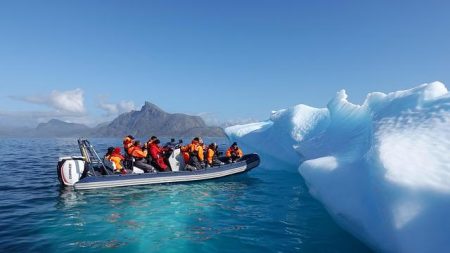



The renewed discussion over whether the United States could someday expand its territory to include Greenland has once again thrust the Arctic into the center of global strategy debates. What began as a controversial idea floated during Donald Trump’s presidency—publicly suggesting that Washington might purchase Greenland from Denmark—was widely mocked at the time. Yet the question behind it has not disappeared. As competition intensifies among major powers in the High North and concerns grow over Russian and Chinese activities in the polar region, U.S. interest in Greenland’s strategic location and resources is only deepening.
Greenland is an autonomous territory within the Kingdom of Denmark, embedded in NATO’s security framework and home to critical U.S. military infrastructure. Any move by Washington to secure greater control over the island would therefore go far beyond a simple “land deal.” It would confront a complex mix of alliance politics, international law, and local self-governance. This article explores how the United States might realistically expand its influence in Greenland, which legal and diplomatic mechanisms could be involved, and why any serious attempt to alter its status would likely provoke friction with Denmark, NATO allies, and other Arctic stakeholders.
From Trump’s Proposal to Long-Term US Arctic Strategy
Trump’s floated proposal to “buy” Greenland briefly turned a long-simmering strategic issue into a late-night punchline. Yet for defense planners and Arctic specialists in Washington, it raised a serious question: how far should the United States go to secure its interests in the Arctic as the region becomes more accessible and contested?
Rising temperatures are reshaping the Arctic at a rapid pace. According to recent climate assessments, the region is now warming at roughly four times the global average, accelerating sea-ice loss and exposing new shipping routes and potential resource deposits. In this context, Greenland’s location between North America, Europe, and the Russian Arctic makes it a pivotal geographic hinge. It sits astride emerging sea lanes linking the Atlantic and Pacific, and it hosts critical infrastructure supporting U.S. and NATO early‑warning capabilities.
As a result, the U.S. policy conversation has shifted far beyond the sensational idea of a territorial purchase. It is now centered on how to deepen America’s presence and partnerships on the island without destabilizing relations with Denmark or undermining Greenland’s autonomy. Tools under consideration or already in motion include:
- Expanded military and dual‑use infrastructure – Upgrading bases, ports, airfields, and radar systems.
- Scientific and climate cooperation – Joint research on ice melt, sea-level rise, and Arctic ecosystems.
- Economic and development initiatives – Investment in connectivity, energy, and local industries.
- Intensified diplomacy with Nuuk and Copenhagen – New consultative mechanisms and regular high-level dialogues.
Yet behind these options lies a dense thicket of constraints—legal, political, and logistical—that make any attempt to “tighten” U.S. control over Greenland deeply complicated.
Core Constraints: Alliance Politics, Local Autonomy, and Great-Power Rivalry
Unlike colonial-era territorial swaps, modern governance frameworks and democratic expectations limit what any state can do in reshaping sovereignty. For Greenland, three interlocking pressure points define the debate:
- Alliance unity – The United States must weigh its strategic ambitions against concerns among NATO allies about militarizing the Arctic and disrupting alliance cohesion.
- Local consent – Greenland’s elected leaders, Indigenous communities, and civil society expect meaningful participation in any decision touching on defense, environment, or economic development.
- Great‑power scrutiny – Moscow and Beijing closely monitor U.S. actions, ready to counter them through military deployments, investments, or diplomatic initiatives in the wider Arctic.
| Strategic Factor | Why It Matters |
|---|---|
| Thule Air Base | Key hub for U.S. missile warning, space surveillance, and Arctic monitoring operations. |
| Sea Routes | New Arctic shipping corridors promise shorter transit between the Atlantic and Pacific, with commercial and military implications. |
| Rare Minerals | Greenland’s deposits could help diversify supply chains away from Chinese-dominated critical mineral markets. |
Why Purchasing Greenland Is Legally and Diplomatically Fraught
Even if there were political consensus in Washington to explore acquiring Greenland outright—a scenario that currently appears improbable—the path forward would run headlong into modern international legal norms. Any transfer of sovereignty would need to comply with the UN Charter, core principles of self‑determination, and a network of agreements governing Greenland’s autonomy within the Kingdom of Denmark.
Since Greenland gained home rule in 1979 and expanded self-government in 2009, Nuuk has acquired authority in most domestic areas, with Copenhagen retaining control over foreign affairs, security, and monetary policy—though even these are increasingly shaped by consultation with Greenlandic leaders. As a result, any discussion of changing Greenland’s status can no longer be decided purely in Copenhagen or Washington; the people of Greenland would have to approve such a shift, likely through both parliamentary processes and a referendum.
On top of this, Greenland’s position within a NATO member state adds more layers. A sovereignty transfer would trigger alliance consultations, potentially demand new defense agreements, and invite scrutiny over how such a deal would affect NATO’s posture in the North Atlantic and Arctic. European officials also worry about the precedent: if a powerful ally can purchase strategically important territory from another democracy, what does that say about territorial integrity norms in 21st‑century Europe?
European and Greenlandic Red Lines
Danish governments—across the political spectrum—have been explicit that Greenland is not “for sale.” Greenland’s leaders, for their part, emphasize the right to decide their own future, whether that entails closer integration with Denmark, increasing autonomy, or eventual independence.
Experts widely agree that any realistic U.S. approach would resemble a complex package of security cooperation, economic engagement, and institutionalized dialogue rather than a simple purchase. Such an approach must navigate several sensitive issues:
- Sovereignty and consent: Greenland insists on a decisive voice in any long-term arrangement, including defense and resource use.
- NATO cohesion: Allies remain wary of intra-alliance bargaining that could fracture the bloc or appear to monetize security geography.
- EU–US tensions: Brussels, which has stepped up its Arctic policy, could interpret a purchase bid as an overreach that sidelines European interests.
- Arctic governance regimes: Multilateral accords on environmental protection, fisheries, and resource management might require revision if sovereignty or control shifted.
| Key Actor | Main Concern |
|---|---|
| Denmark | Preserving sovereignty, maintaining stable alliance relations |
| Greenland | Self-determination, economic leverage in dealings with larger powers |
| United States | Long-term Arctic access, early-warning and defense posture |
| NATO / EU | Upholding norms against transactional territorial deals in Europe |
How US Moves in Greenland Could Test NATO Unity and Arctic Stability
Any unilateral-style push by the United States to expand its role on Greenland—whether through aggressive basing demands, exclusive economic agreements, or rhetoric about acquisition—would confront a delicate balance inside NATO. Denmark regards Greenland as an inseparable component of the Kingdom, while U.S. strategists see it as a forward bastion to monitor Russian forces in the North Atlantic, respond to Chinese polar ventures, and secure sea lines of communication.
Diplomats warn that even the perception of U.S. heavy‑handedness could trigger political backlash in Europe, revitalize debates about unequal influence within NATO, and feed arguments that Washington treats allied territory as an extension of its own defense perimeter. This is especially sensitive at a time when European governments are already grappling with burdensharing disputes, defense-spending targets, and war on the continent’s eastern flank.
Security analysts also caution that even modest changes—expanded radar arrays, upgraded runways capable of hosting more frequent bomber or surveillance flights, or new dual‑use ports—could reverberate across the Arctic security environment. Russia might respond with additional air and naval deployments in the Barents and Kara Seas; China could deepen investments in alternative Arctic hubs, including in Russia or Iceland, to counterbalance U.S. influence.
- Alliance cohesion: Disagreements over U.S. policy in Greenland could expose deeper tensions regarding decision‑making, consultation, and strategic priorities within NATO.
- Arms control and escalation risks: Additional missile‑defense systems, drones, or anti‑submarine platforms in and around Greenland could erode remaining arms‑control arrangements and fuel a military buildup in the High North.
- Indigenous and local governance: If major security decisions appear to bypass Nuuk or ignore Inuit concerns about land use and environmental impacts, the legitimacy of Greenland’s home‑rule institutions could be undermined.
- Russian and Chinese counter‑moves: Joint exercises, increased under‑ice submarine activity, and expanded infrastructure in other Arctic regions could follow any major U.S. expansion on the island.
| Actor | Main Interest | Potential Reaction |
|---|---|---|
| United States | Missile warning, secure Arctic access and presence | Seek larger, more permanent bases and supporting infrastructure |
| Denmark/Greenland | Sovereignty protection, local political autonomy | Press for stricter political oversight and transparent agreements |
| NATO Allies | Alliance unity, fair burden-sharing | Insist on collective decision‑making on major Arctic deployments |
| Russia/China | Strategic parity, resource access, freedom of navigation | Increase Arctic deployments, investments, and diplomatic engagement |
Why Transparent Diplomacy with Denmark and Greenland Is Essential
Policy experts across Europe and North America increasingly converge on one central point: any expanded U.S. footprint in Greenland must rest on clear, predictable, and inclusive diplomacy. Secretive or unilateral tactics could not only strain relations with Denmark but also undercut Greenland’s evolving self-rule and fuel domestic opposition on both sides of the Atlantic.
Analysts emphasize that Washington needs a public framework for engagement that signals respect for existing treaties and institutional arrangements, rather than an attempt to sidestep them. That framework, they argue, should include:
- Tripartite communication – Regular, joint statements and briefings by U.S., Danish, and Greenlandic leaders outlining objectives and timelines.
- Legal transparency – Publication of legal analyses related to sovereignty, self-determination, and NATO obligations in the Arctic context.
- Meaningful consultation with Inuit and local authorities – Guaranteed seats at the table for municipal leaders and Indigenous organizations on issues ranging from infrastructure siting to emergency preparedness.
- Independent oversight mechanisms – External review of environmental impacts, social effects, and security risks associated with any major expansion of U.S. activities.
Think tanks and academic institutes have begun sketching out principles for future negotiations. Many recommend that any new or revised agreements on bases, investment, or scientific collaboration include binding provisions on transparency, environmental safeguards, and participation of Greenlandic lawmakers.
| Actor | Primary Concern |
|---|---|
| Denmark | Maintaining legal control, alliance cohesion, and domestic legitimacy |
| Greenland | Strengthening self-rule, maximizing economic and political leverage |
| United States | Securing Arctic access, reinforcing its security posture and early‑warning network |
Looking Ahead: Greenland as a Test Case for US Power in the High North
In the coming years, the question of a deeper U.S. role in Greenland will continue to function as a barometer of how Washington balances great‑power competition with alliance management and respect for local decision‑making. Any expansion of its footprint—whether through new defense infrastructure, economic initiatives, or political agreements—will have to navigate intricate legal arrangements, domestic sensitivities in both Denmark and Greenland, and reactions from other Arctic players.
Even if the headline‑grabbing idea of outright acquisition fades into the background, the debate it sparked has already highlighted Greenland’s ascent as a strategic crossroads. As climate change redraws the Arctic map and rival powers step up their presence, the island will remain central to discussions about security, sovereignty, and the future of U.S. engagement in the High North. How Washington, Copenhagen, and Nuuk manage this evolving relationship could shape not only the stability of the Arctic but also wider transatlantic relations for decades to come.