



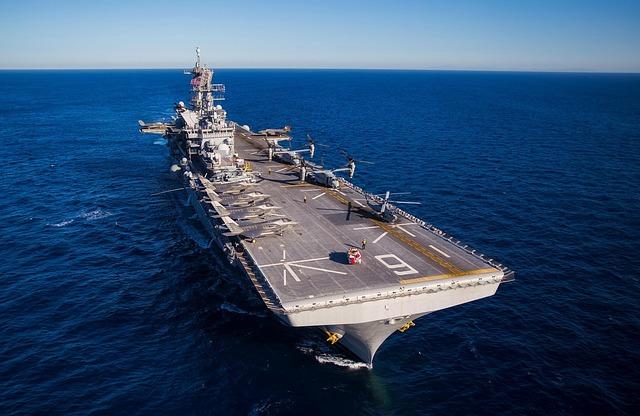
USS George Washington Reaches Landmark in Carrier Aviation, Showcasing a New Era of Naval Air Power
The USS George Washington has opened a new chapter in carrier aviation, setting a major aircraft operations milestone while deployed in support of U.S. defense missions abroad. This Nimitz-class aircraft carrier—long a symbol of American maritime strength—achieved the record during a recent deployment, reinforcing the central role of carrier-based air power in global security and deterrence. According to the U.S. Department of War, this accomplishment not only highlights the ship’s durability and flexibility, but also represents the cumulative impact of decades of innovation, disciplined training, and the relentless work of sailors and aviators who keep its air wing on the cutting edge.
Next-Generation Air Wing Helps USS George Washington Set Historic Sortie Milestone
At the heart of the achievement is a nuclear-powered carrier operating as the flagship of a Carrier Strike Group, which has pushed the boundaries of sustained air operations. During this deployment cycle, USS George Washington launched a record number of sorties while synchronizing some of the most advanced aircraft in the U.S. Navy inventory.
Flight deck personnel, aviation ordnancemen, and maintenance crews executed near-continuous flight operations—day and night—to support a demanding schedule of strike, intelligence, surveillance and reconnaissance (ISR), and electronic warfare missions. Defense officials note that this tempo demonstrates both the carrier’s revitalized warfighting capacity and the growing importance of fifth-generation and unmanned platforms in securing maritime dominance in increasingly contested and distributed theaters.
This performance was powered by an integrated air wing that merges proven aircraft with emerging technologies into a cohesive, high-output combat formation. Core components of the embarked air wing included:
- F-35C Lightning II – Carrier-optimized stealth fighter delivering long-range precision strike, sensor fusion, and advanced battlespace awareness.
- F/A-18E/F Super Hornet – Versatile multirole aircraft providing air superiority, strike, and close air support.
- EA-18G Growler – Specialized electronic attack platform offering stand-off jamming and suppression of enemy air defenses.
- CMV-22B Osprey – Tiltrotor aircraft serving as a high-speed, long-range logistics connector for critical parts, mail, and personnel.
- MQ-25 Stingray (early integration) – Uncrewed refueling asset designed to extend range, endurance, and flexibility of carrier-based air operations.
| Metric | Record Figure | Operational Impact |
|---|---|---|
| Total Sorties | 4,500+ | Broader regional reach and persistent presence |
| Peak Daily Launches | 160 | Demonstrated high-end surge capability |
| Aircraft Mix | 7 Types | Enhanced multi-domain mission options |
| On-Time Mission Rate | 96% | Higher reliability and predictable output |
In the broader context of U.S. naval aviation, these numbers place USS George Washington among the top-performing carriers of the last decade, aligning with the Navy’s push toward distributed maritime operations and resilient, high-tempo air campaigns.
Data-Driven Readiness: How Analytics Transformed Training and Maintenance
Senior Navy leaders credit a quiet but profound shift in how the fleet uses data as a key driver behind the carrier’s record-breaking performance. Modern analytics now inform virtually every aspect of the air wing’s readiness cycle—from pilot training plans to spare parts staging and engine overhauls.
Fleet planners have introduced real-time performance dashboards, predictive maintenance tools, and digital tracking for training events that sharply reduce guesswork. What were once paper-heavy readiness reviews based on static spreadsheets and anecdotal feedback are now dynamic, data-rich sessions drawing directly from shipboard sensors and aviation databases. Commanders can identify emerging problems in hours rather than weeks, adjust sortie schedules, and reallocate resources before minor issues become mission-impacting.
On the deck and in the hangar bays, sailors describe a more targeted and quantifiable approach to readiness. Training hours, simulator events, and maintenance windows are closely aligned with metrics that correlate best with mission success. Aviation squadrons analyze sortie-level performance to refine flight syllabi and simulator scenarios, while engineering and maintenance teams use condition-based alerts to repair or replace components prior to failure.
These reforms have translated into measurable gains across key readiness indicators:
- Real-time readiness tracking fuses aircraft status, crew qualifications, and supply levels into a single operational picture.
- Predictive analytics rank maintenance actions by impact on sortie generation and mission capability.
- Targeted training cycles emphasize the skills and scenarios most strongly linked to combat effectiveness.
- Streamlined supply chains shorten lead times for mission-critical parts and reduce logistics bottlenecks.
| Metric | Before Reform | After Reform |
|---|---|---|
| Mission-Capable Jets | ~60% | ~78% |
| Unplanned Maintenance | High | Reduced |
| Training Sortie Cancellations | Frequent | Occasional |
| Data-Linked Crew Drills | Limited | Standard |
These trends mirror wider U.S. defense efforts: by 2024, the Pentagon has expanded the use of predictive maintenance across multiple fleets, with some programs reporting double-digit reductions in unscheduled downtime and cost savings measured in hundreds of millions of dollars.
Carrier Power and Indo-Pacific Deterrence: A Flexible Tool for a Contested Region
The achievements aboard USS George Washington carry strategic weight far beyond the ship’s wake. In the Indo-Pacific—a region now accounting for a major share of global economic output and maritime trade—carrier aviation remains a visible and adaptable instrument of deterrence. Defense officials argue that the ability to sustain high-intensity flight operations sends a clear signal: the United States can rapidly transition from routine presence to combat-ready posture if required.
Within this framework, the carrier contributes to a broader deterrence architecture centered around:
- Persistent carrier patrols near vital sea lanes, chokepoints, and strategic straits.
- Integrated air wings that combine precision strike, ISR, and electronic warfare into a unified force package.
- Dynamic basing models that vary deployment routes and operating areas to reduce predictability.
- Real-time data sharing with joint and allied forces to create a common operational picture.
| Carrier Effect | Deterrence Impact |
|---|---|
| Forward air power | Raises the cost and risk of potential aggression |
| Visible presence | Communicates U.S. commitment and resolve to allies and competitors alike |
| Joint exercises | Deepens interoperability and strengthens alliance cohesion |
Commanders see the George Washington’s sortie-generation record, and its close integration with regional partners, as central to a power-projection strategy designed for long-term competition rather than short, decisive clashes. By coordinating with allied navies and air forces, Carrier Strike Groups can create layered zones of security that support freedom of navigation operations, crisis response, and humanitarian assistance.
In operational terms, this approach enables:
- Accelerated surge capability to respond to sudden regional tensions or natural disasters.
- Expanded combined training that validates interoperability under realistic, high-stress conditions.
- Tailored force packages blending manned aircraft, unmanned systems, cyber capabilities, and space-enabled sensors.
- Carefully calibrated signaling aimed at deterring miscalculation without escalating to open conflict.
As Indo-Pacific nations increase their own defense investments, including carrier programs in several regional navies, the U.S. approach emphasizes not just presence, but integration—making each carrier deployment a platform for multilateral cooperation.
Future of Carrier Aviation: Modernization, People, and Allied Integration
Looking ahead, defense planners see the next decade of carrier aviation as defined by three converging priorities: advanced platforms, digital modernization, and resilient human talent. Analysts within the Department of War stress the importance of fielding long-range, low-signature aircraft, hardening command-and-control networks against cyber and electronic attack, and building data-centric maintenance ecosystems that harness predictive analytics on every ship.
Emerging concepts point toward a “blended” air wing in which crewed fighters, uncrewed systems, and electronic warfare assets operate together as a cohesive, software-adaptable combat cloud. Lessons drawn from USS George Washington’s milestone deployment are already informing investment roadmaps that emphasize:
- Investment Priorities: Stealth, range, autonomy across manned and unmanned platforms.
- Modernization Focus: Networked sensors, secure data fusion, and open-architecture mission systems.
- Personnel Imperative: Training aircrew and deck crews for manned–unmanned teaming and advanced digital tools.
- Allied Dimension: Common standards, interoperable systems, and shared doctrine to enable combined operations.
| Domain | Near-Term Goal | Allied Role |
|---|---|---|
| Air Wing | Deploy mixed manned–unmanned squadrons at scale | Joint testing, evaluation, and concept development |
| Digital | Implement a secure, shared data layer across platforms | Common threat databases and intelligence sharing |
| Training | Expand live-virtual-constructive (LVC) training environments | Combined carrier strike group and air wing exercises |
Despite rapid advances in automation and autonomy, senior leaders repeatedly emphasize one constant: people remain decisive. As threat timelines compress and flight decks become more complex, demand is growing for highly skilled specialists in cyber defense, data analytics, advanced avionics, and remote operations.
To meet this demand, the Department is evaluating expanded career pipelines for carrier aviation specialists, including cross-training programs that bridge traditional pilot roles with expertise in unmanned operations and digital systems. At the same time, allied integration is shifting from periodic, event-based exercises to persistent, network-enabled collaboration. Partner nations are gaining greater access to U.S. doctrine, simulation environments, and mission rehearsal tools—allowing multinational air wings to train as they would fight.
The operations logged aboard USS George Washington are increasingly seen as a prototype for this future. The carrier’s experience points toward an environment where U.S. and allied air assets can plug into shared mission networks, coordinate logistics and maintenance in real time, and present a unified, multinational front across the maritime domain.
Conclusion: A Milestone That Points to the Future of Naval Aviation
As USS George Washington continues its operations at sea, the record-setting milestone on its flight deck represents far more than a standout statistic. It encapsulates years of technological refinement, disciplined training, and perseverance by generations of sailors and aviators. Even as the Navy prepares for new platforms, evolving threats, and increasingly complex joint operations, the achievements aboard “GW” illustrate the enduring relevance of the aircraft carrier in U.S. maritime strategy.
With this milestone recorded in the ship’s log, the crew returns to the steady rhythm of carrier life—preparing for the next launch, the next arresting landing, and the next benchmark in a tradition of naval aviation that continues to shape American influence and security on the world’s oceans.